
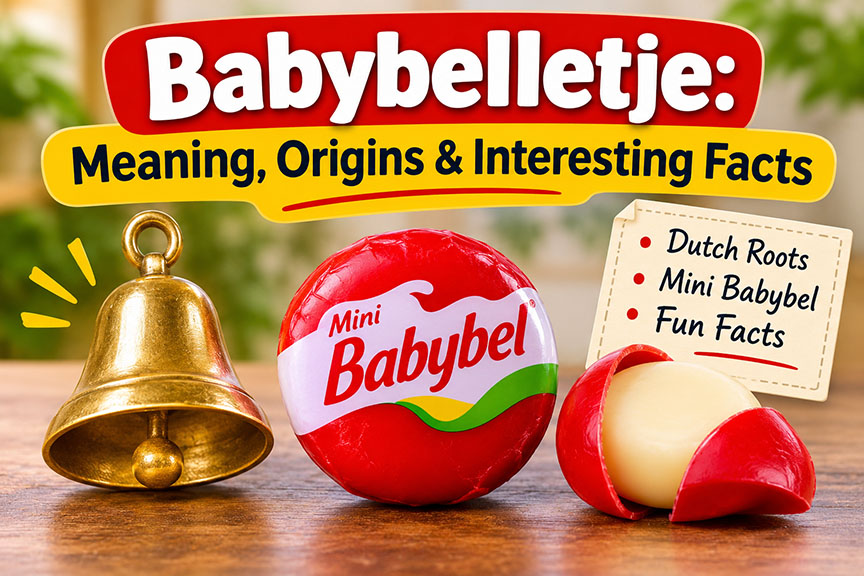
Some words attract attention because they sound familiar, while their actual meaning is not immediately obvious. Babybelletje is one such word. Its unusual spelling, playful sound, and connection to Dutch language patterns make it an interesting subject for anyone exploring unfamiliar expressions.
People searching for Babybelletje may encounter different explanations. Some connect it with a small bell, while others associate it with the popular Babybel cheese brand. These interpretations are related to recognizable words, but they should not automatically be treated as official definitions.
The best way to understand Babybelletje is to examine its possible linguistic roots, its relationship with Dutch diminutive words, and the way it is used in everyday and online conversations. Looking at these details also helps separate established information from interpretations that have not been independently confirmed.
In this guide, we explore the meaning of Babybelletje, its possible origins, its connection to Mini Babybel, and several interesting facts that explain why this unusual expression deserves attention.
What Does Babybelletje Mean?
Babybelletje is an unusual expression without one universally established dictionary definition. Its meaning depends largely on the context in which it appears.
One useful starting point is the Dutch word belletje. This is a diminutive form of bel, which means bell. A diminutive is a word form that can communicate small size, familiarity, or affection.
When someone encounters Babybelletje, they might interpret it in two ways:
-
A little bell: The Dutch word element suggests a small bell or something associated with a bell.
-
A little Babybel: In a food-related conversation, the expression could be an informal, playful reference to a small Babybel cheese.
Neither interpretation should be confused with a confirmed official definition of the complete word.
Understanding the Dutch Word Belletje
Dutch has a distinctive way of creating diminutive forms. Small endings are added to nouns to suggest something smaller or give the expression a softer, more familiar feeling.
For example:
| Dutch word | English meaning |
|---|---|
| Bel | Bell |
| Belletje | Little bell |
| Huis | House |
| Huisje | Little house |
| Boek | Book |
| Boekje | Little book |
These examples demonstrate why the ending in Babybelletje may sound affectionate or playful.
The distinction is important: belletje is an established Dutch word, whereas the complete expression Babybelletje should be treated more cautiously because its exact meaning is not firmly established in standard dictionary usage.
The Possible Origins of Babybelletje
Understanding the possible origins of Babybelletje requires looking at the individual parts of the expression rather than assuming it has one documented historical beginning.
Its Connection to Dutch Language
The strongest linguistic connection comes from the Dutch word belletje. Dutch speakers regularly use diminutives in everyday communication, including when talking about familiar objects, food, and personal belongings.
These forms are not always literal descriptions of size. Sometimes they make a word sound friendlier or more affectionate.
Babybelletje follows a pattern that may feel familiar to people who understand Dutch word formation. However, that linguistic possibility does not prove when the complete expression first appeared or who originally used it.
Its Possible Connection to Babybel Cheese
Another interpretation comes from the recognizable name Babybel.
Babybel is an established cheese brand, and its smaller individually wrapped cheese portions are officially marketed as Mini Babybel. The addition of a Dutch-style diminutive ending could make Babybelletje sound like an affectionate nickname for one of these small cheeses.
This is a plausible interpretation in food-related conversations, but there is an important distinction between informal language and commercial branding.
The manufacturer uses the name Mini Babybel rather than Babybelletje as its established product name.
Is There a Documented Historical Origin?
There is currently insufficient reliable evidence to identify a specific historical event, individual, or date associated with the creation of Babybelletje.
It is better to recognize the expression as a context-dependent term than to assign it an elaborate historical background without supporting documentation.
That approach gives readers a clearer understanding without presenting speculation as established history.
Babybelletje and Mini Babybel: Understanding the Difference
One reason Babybelletje attracts attention is its visual and linguistic similarity to Babybel, the well-known cheese brand.

What Is Mini Babybel?
Mini Babybel is a small, individually portioned cheese snack. It is recognizable because of its round shape and distinctive colored wax coating.
According to the manufacturer’s official product information, the range includes several varieties, such as:
-
Original cheese
-
Reduced-fat cheese
-
Gouda
-
Mozzarella
-
White Cheddar
-
Monterey Jack
-
Plant-based alternatives
The exact selection depends on the market.
The individual packaging makes Mini Babybel convenient for lunchboxes, snacks, and food platters. Its familiar appearance also makes the brand easy to recognize.
Is Babybelletje an Official Cheese Product?
No verified manufacturer information establishes Babybelletje as an official product name.
The official website uses Mini Babybel and other Babybel product names. Therefore, it is more accurate to describe Babybelletje as a possible informal nickname rather than a separate cheese variety.
This distinction matters when writing informational content. Readers should be able to recognize the difference between an established brand name and an expression that simply resembles it.
For accurate product details, the manufacturer’s official Babybel product page is a useful reference.
How Babybelletje Can Be Understood in Different Contexts
The meaning of an unfamiliar expression often becomes clearer when you examine the surrounding conversation.
Babybelletje is a good example because its spelling can suggest more than one interpretation.
1. In Dutch Language Discussions
When the word appears in a discussion about Dutch vocabulary, its connection with belletje is particularly relevant.
A reader may understand it through the meaning of a little bell or a related diminutive expression. The Algemeen Nederlands Woordenboek (ANW), an authoritative Dutch language resource, records several meanings of belletje.
These include:
-
A small bell.
-
The sound produced by a bell.
-
A small button used to activate an electric bell.
-
A small decorative bell.
-
An informal telephone call.
This shows that even the established word belletje has more than one meaning.
2. In Food and Snack Discussions
When Babybelletje appears alongside words such as cheese, lunchbox, snacks, or red wax, the connection with Mini Babybel becomes more likely.
In this situation, the expression may be an affectionate or informal way of referring to a small Babybel cheese.
However, context alone does not make it an official product name.
3. In Baby-Related Conversations
The combination of the word baby and the Dutch word belletje may also suggest a small bell associated with a baby.
For example, someone might use a similar expression when talking about a decorative bell, a toy, or a small musical accessory.
That is a possible interpretation of the word’s components, not evidence that Babybelletje is an established name for a particular baby product.
Interesting Facts About Babybelletje
There are several interesting details worth knowing about this unusual expression.
1. It has a recognizable Dutch connection.
The word belletje is documented in Dutch language resources. Its basic meaning includes a small bell.
2. Dutch diminutives communicate more than size.
A diminutive can make a word sound familiar, affectionate, or informal. It does not always describe an object’s physical dimensions.
3. The complete expression has an uncertain status.
Although its individual components are understandable, Babybelletje should not automatically be treated as a standard dictionary word.
4. It resembles an established cheese brand.
The similarity to Babybel makes the expression particularly interesting in food-related searches.
5. Context determines the most reasonable interpretation.
A discussion about Dutch vocabulary may point toward a little bell, while a conversation about cheese may suggest an informal reference to Mini Babybel.
6. Online explanations are not always equally reliable.
A website repeating an unusual definition does not necessarily establish its historical accuracy. Checking dictionaries and official manufacturer information provides a stronger foundation.
Why Understanding Babybelletje Matters
Learning the meaning of unfamiliar words is useful beyond simply increasing vocabulary. It helps people understand conversations, recognize cultural differences, and avoid confusing similar-looking expressions.
Babybelletje also demonstrates how language can develop through informal combinations. People regularly create playful expressions by joining familiar words or adapting names to suit everyday conversations.
These expressions can become recognizable within a particular group without becoming formal dictionary entries.
For readers, the most useful approach is to consider the source of the word, the subject being discussed, and the surrounding sentence.
For writers and researchers, this distinction is especially important. An article should explain what is supported by reliable evidence while making it clear when a particular interpretation is only a possibility.
Frequently Asked Questions About Babybelletje
1. What does Babybelletje mean?
Babybelletje is a context-dependent expression. It may suggest a little bell through its Dutch linguistic connection or serve as an informal nickname for a small Babybel cheese. The complete expression does not have one firmly established universal definition.
2. Is Babybelletje a Dutch word?
The related word belletje is established Dutch vocabulary. It is a diminutive of bel, meaning bell. However, Babybelletje should not automatically be considered a standard Dutch dictionary entry.
3. Is Babybelletje the same as Mini Babybel?
Not officially. Mini Babybel is the established product name for the individually portioned cheese. Babybelletje may be used informally in food-related conversations, but it is not a verified separate product name.
4. What does belletje mean in English?
The Dutch word belletje can mean a little bell or the sound of a small bell. Depending on the context, it can also refer to other bell-related objects or an informal telephone call.
5. Where does the word Babybelletje come from?
Its exact historical origin has not been established. Its recognizable linguistic connection comes from the Dutch word belletje, while its spelling also resembles the Babybel cheese brand.
6. Why do people search for Babybelletje?
People may encounter the expression through online articles, unfamiliar Dutch vocabulary, or references to Babybel cheese. Its unusual spelling and multiple possible interpretations can naturally create curiosity.
Conclusion
Babybelletje is an interesting expression because it connects recognizable language elements with different possible interpretations. Its strongest linguistic connection is the Dutch word belletje, meaning a little bell, while its similarity to Babybel creates another possible interpretation in food-related conversations.
The important distinction is that the complete expression does not have one universally established meaning. Mini Babybel is an official cheese product, and belletje is documented Dutch vocabulary, but Babybelletje should be understood according to its context rather than presented as an established product, tradition, or historical term.
Whether someone encounters it while exploring Dutch vocabulary or reading about familiar snack foods, understanding these distinctions makes the expression much easier to interpret.
Ultimately, Babybelletje is a useful example of how language, familiar names, and informal expressions can overlap, creating words that attract attention and invite further exploration.
