
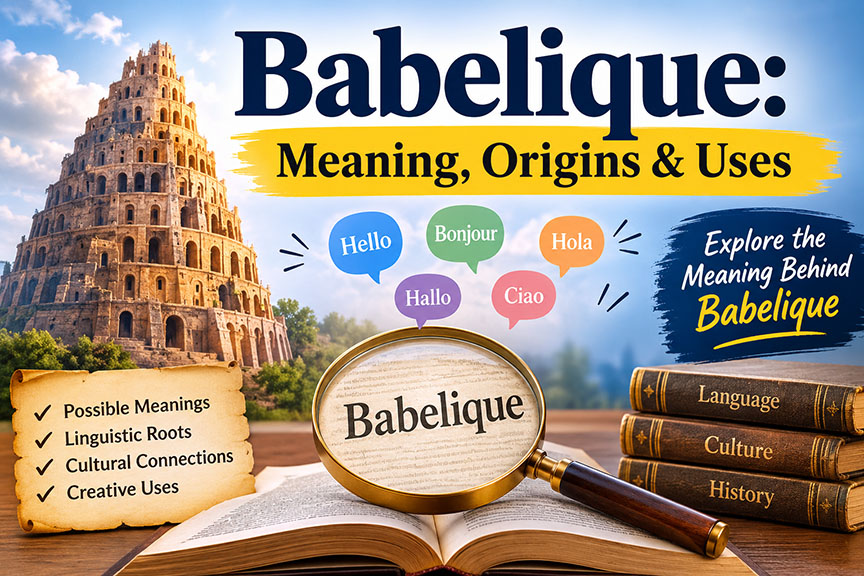
But what does Babelique actually mean? Is it a traditional word, a modern expression, or a creative term? Understanding the answer requires looking at its possible linguistic connections, the contexts in which it might appear, and the importance of interpreting unfamiliar vocabulary carefully.
Babelique does not have a widely established dictionary definition that can confidently be applied in every situation. Its meaning may depend on how and where it is used. This guide explores the term, its possible origins, interpretations, practical uses, and relevance in modern communication.
What Does Babelique Mean?
Babelique is an uncommon term without a universally recognized definition in standard English dictionaries. This makes its interpretation dependent on context rather than a single fixed meaning.
One possible linguistic connection is the word Babel, which is historically associated with the biblical story of the Tower of Babel. In that story, different languages emerge, creating communication difficulties among people.
Because of this association, Babelique may be interpreted creatively in ways connected to:
-
Language diversity and multilingual communication.
-
Different cultures and forms of expression.
-
Confusing or complicated conversations.
-
Creative language and unusual terminology.
-
Ideas involving communication across boundaries.
These are possible interpretations, not confirmed dictionary meanings. Anyone researching the term should distinguish between an established definition and a meaning suggested by creative or contextual use.
Possible Origins and Linguistic Background of Babelique
Understanding an unfamiliar word often begins with examining its structure and possible linguistic influences.
Connection to the Word Babel
The most recognizable part of Babelique is its opening element, Babel. The name Babel is widely known through the biblical account of the Tower of Babel, where a shared language is disrupted and people struggle to understand one another.
Over time, Babel has also become associated with linguistic confusion, multiple languages, and communication barriers.
This connection makes it reasonable to explore whether Babelique is being used to suggest similar ideas. However, a shared word element does not prove that two terms have the same historical origin.
The Influence of French-Looking Word Forms
The ending of Babelique may remind readers of French adjectives and other words with similar spelling patterns.
French contains many words ending in forms such as -ique, including terms used to describe styles, characteristics, and concepts. English also borrows vocabulary from French, which contributes to the familiarity of this pattern.
Nevertheless, the spelling alone does not establish that Babelique is a French word or follows a recognized French grammatical structure.
Is Babelique an Established Historical Word?
There is insufficient reliable evidence to identify Babelique as a widely documented historical term with a confirmed origin and consistent definition.
It may be a coined expression, a name, a creative spelling, or a term used within a particular online or cultural context.
For accurate research, it is important to examine the original source where the word appears rather than assigning it an unsupported historical background.
How Is Babelique Used?
Since Babelique does not have one confirmed, widely accepted definition, its practical use depends on the context in which it appears. It may be encountered as a creative name, an online keyword, or an expression chosen for its distinctive appearance.
Here are several possible contexts in which the term could be used.
1. Creative Writing and Storytelling
Writers often experiment with unfamiliar words to create memorable names, fictional places, or imaginative concepts. Babelique could work as a fictional name or an expression in a story involving language, cultural differences, or unusual environments.
For example, an author might use it as the name of an imaginary city where people from different backgrounds communicate in different languages.
This is a creative application rather than an established literary meaning.
2. Branding and Naming
Distinctive words can be useful when developing a brand identity. Babelique has an unusual spelling and a recognizable connection to the word Babel, which may make it interesting for creative naming projects.
Potential applications include:
-
A language-learning project.
-
A cultural or artistic platform.
-
A creative writing publication.
-
A fictional fashion or lifestyle brand.
-
A multilingual communication project.
Anyone considering Babelique as a business or product name should first check trademark availability, domain registration, and existing commercial uses.
3. Digital Content and Online Searches
Uncommon keywords sometimes attract attention because people want to understand what they mean. Someone searching for Babelique may have encountered it in a website, social media post, product description, username, or another online source.
The most useful approach is to investigate the original appearance of the word. Its surrounding text, author, and subject matter may provide clues about the intended meaning.
A search result alone does not establish that a word has an official definition.
4. Cultural and Linguistic Discussions
The possible association with Babel makes the term interesting to explore in discussions about language and cultural diversity.
Different languages influence the way people communicate, express ideas, and understand the world. A creative term connected with Babel could therefore be used to represent the complexity of communication between different communities.
However, this interpretation should be presented as an imaginative association rather than a verified definition of Babelique.
Why Is Babelique Interesting?
Unfamiliar vocabulary can generate curiosity, especially when a word resembles recognizable expressions but does not have an obvious meaning.
Several characteristics make Babelique interesting to investigate.
Its distinctive spelling: The combination of familiar and unusual letter patterns makes the term visually recognizable.
Its possible linguistic association: The connection with Babel offers an interesting starting point for exploring language, communication, and cultural diversity.
Its flexible interpretation: Without a firmly established definition, the term can appear in different creative contexts. Its meaning must be understood through actual usage.
Its potential as a name: Uncommon expressions can attract attention in creative projects, although originality and availability should always be checked before commercial use.
The important distinction is that an interesting interpretation is not necessarily an established linguistic fact.
Babelique and the Tower of Babel: Understanding the Connection
To understand why Babelique might remind readers of language diversity, it helps to examine the historical and cultural significance of Babel.
The Tower of Babel story appears in Genesis 11:1–9. According to the biblical narrative, people initially shared one language and worked together to build a city and a tower. Their language was then confused, making communication difficult and resulting in their dispersal.
The story has become an important cultural reference when discussing linguistic differences and communication barriers.
The word Babel is also used in broader discussions of confusing or mixed speech. This association explains why an unfamiliar expression beginning with Babel might suggest similar themes.
However, there is an important distinction:
-
Babel is an established name associated with the biblical narrative and Babylon.
-
Babelique does not have an equally established historical or dictionary meaning.
-
Any relationship between the two should be treated as a possible linguistic or creative connection unless reliable evidence establishes a direct origin.
Readers interested in the original story can consult Genesis 11:1–9 on Bible Gateway for the biblical passage.
How to Understand the Meaning of Babelique Correctly
When encountering an unfamiliar word, it is easy to assume that its spelling reveals its meaning. However, that approach can produce inaccurate explanations.
A better method involves examining the available evidence.
Check the Original Source
Start by identifying where Babelique appeared. Was it used in an article, a business name, a social media account, or a fictional story?
The source can provide important information about the intended meaning.
Examine the Surrounding Words
Look at the sentences before and after the term. These may reveal whether it describes a person, object, idea, organization, or creative concept.
Compare Possible Linguistic Connections
If the word resembles vocabulary from another language, investigate that connection using reliable dictionaries and linguistic references.
Do not assume that similar spelling automatically means shared origin.
Look for Consistent Usage
If the same term appears across several independent sources, compare how those sources use it. Consistent usage may help establish a more specific interpretation.
Avoid Unsupported Definitions
If reliable evidence is unavailable, acknowledge the uncertainty. A careful explanation is more useful than presenting an invented definition as historical fact.
Frequently Asked Questions About Babelique
1. What does Babelique mean?
Babelique is an uncommon term without a widely established dictionary definition. Its meaning depends on the context in which it appears. It may also invite creative interpretations connected with language and communication.
2. Is Babelique a real word?
Babelique can certainly be used as a written expression or coined term. However, there is insufficient evidence to describe it as a widely recognized standard English or French vocabulary word.
3. What is the origin of Babelique?
Its confirmed historical origin is unclear. The beginning resembles Babel, a name associated with the biblical Tower of Babel, while its ending resembles certain French word patterns. These similarities do not establish its actual etymology.
4. Is Babelique a French word?
There is no reliable basis for identifying Babelique as a standard French word. Its spelling may look French-inspired, but appearance alone cannot confirm its language or grammatical status.
5. Can Babelique be used as a brand name?
Yes, it could be considered as a creative naming option. However, anyone planning to use it commercially should research existing businesses, trademarks, domain names, and potential meanings in relevant markets.
6. Why are people searching for Babelique?
People may search for unfamiliar terms after encountering them online, in creative content, or in a particular naming context. Without reliable search-trend evidence, it is not possible to identify one specific reason for its popularity.
Conclusion
Babelique is an unusual term that invites curiosity because of its distinctive spelling and possible connection with the familiar word Babel. Although its exact meaning and historical origin remain uncertain, exploring its linguistic appearance provides an interesting opportunity to discuss vocabulary, cultural influences, and creative expression.
The most important thing is to separate confirmed information from possible interpretations. Babel has a recognizable historical and biblical background, while Babelique does not have a similarly established definition.
Whether encountered in online content, creative writing, or as a potential brand name, the term should be interpreted according to its original context. Understanding that distinction helps readers explore unfamiliar vocabulary without relying on misleading explanations.
